A few days ago I picked up my friend Kresten from the airport in Christchurch. I had already been fishing the South Island of New Zealand for several weeks and had been teasing him with pictures of caught fish in great condition. Now he was finally here and hungry for fish. We started out successfully fishing a few spring creeks while the weather settled. With our thirst for trout now sated, we decided that once the weather window allowed us to, we would go on a big backcountry mission.
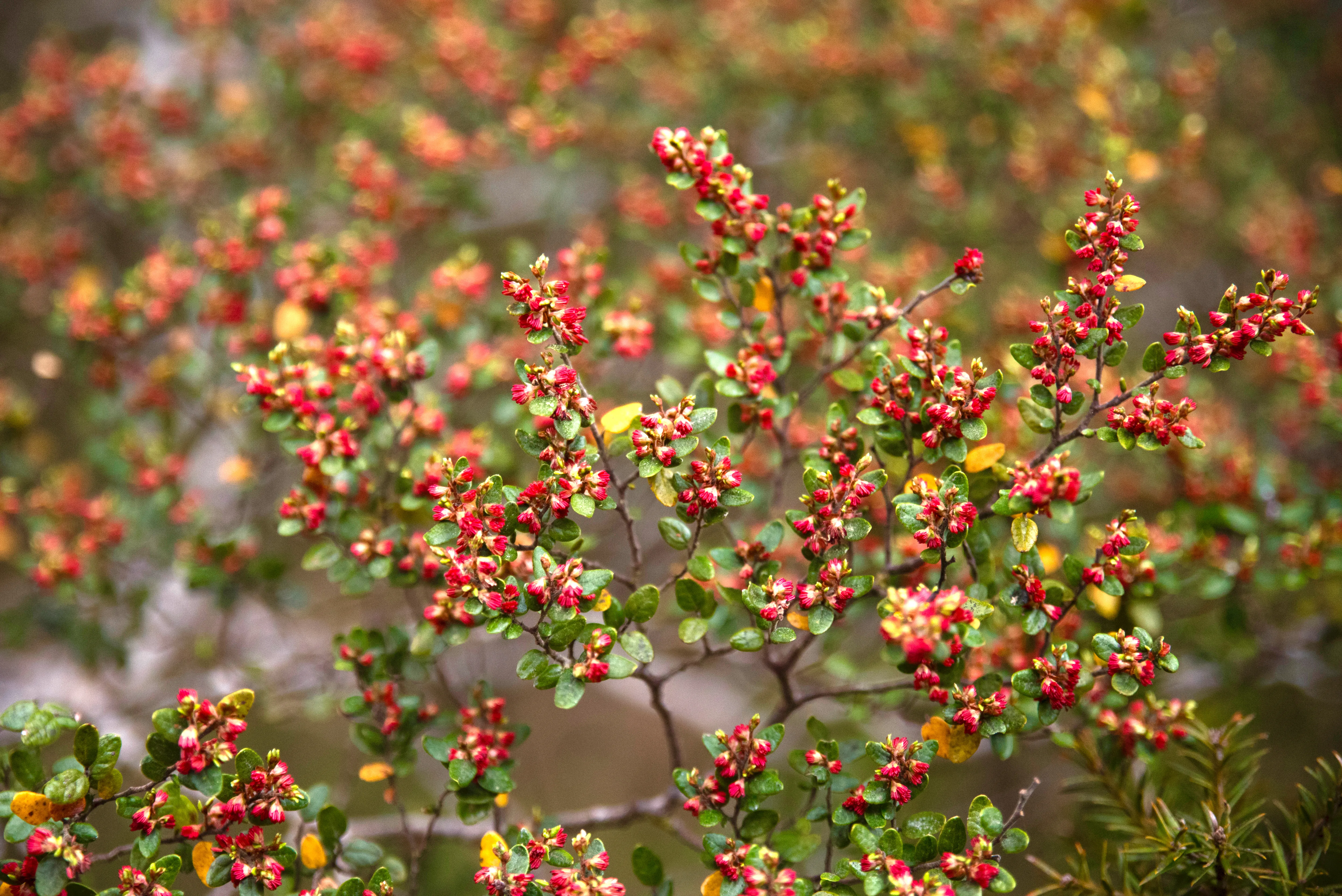
I suspected we might have a chance of finding a real treasure in our river of choice. I had visited the river the prior season, and I do not understate when I say that the beech bush was more red than green in this particular valley. Mind you, I’m not color blind either. The avid New Zealand trout angler knows that a flowering beech forest is followed by a mast event, which in turn creates a massive spike in rodent populations—particularly mice—that feed on the beech seed. Trout then feast on these mice during the following spring and summer and these so-called mouse fish can obtain gargantuan proportions.
However, we hadn’t heard anything confirming if there was a mouse hatch going, and it was now February and thus late summer. So we guessed we had to do the hard work ourselves. Did that sound bad? Not at all. Super exciting? Very much so!
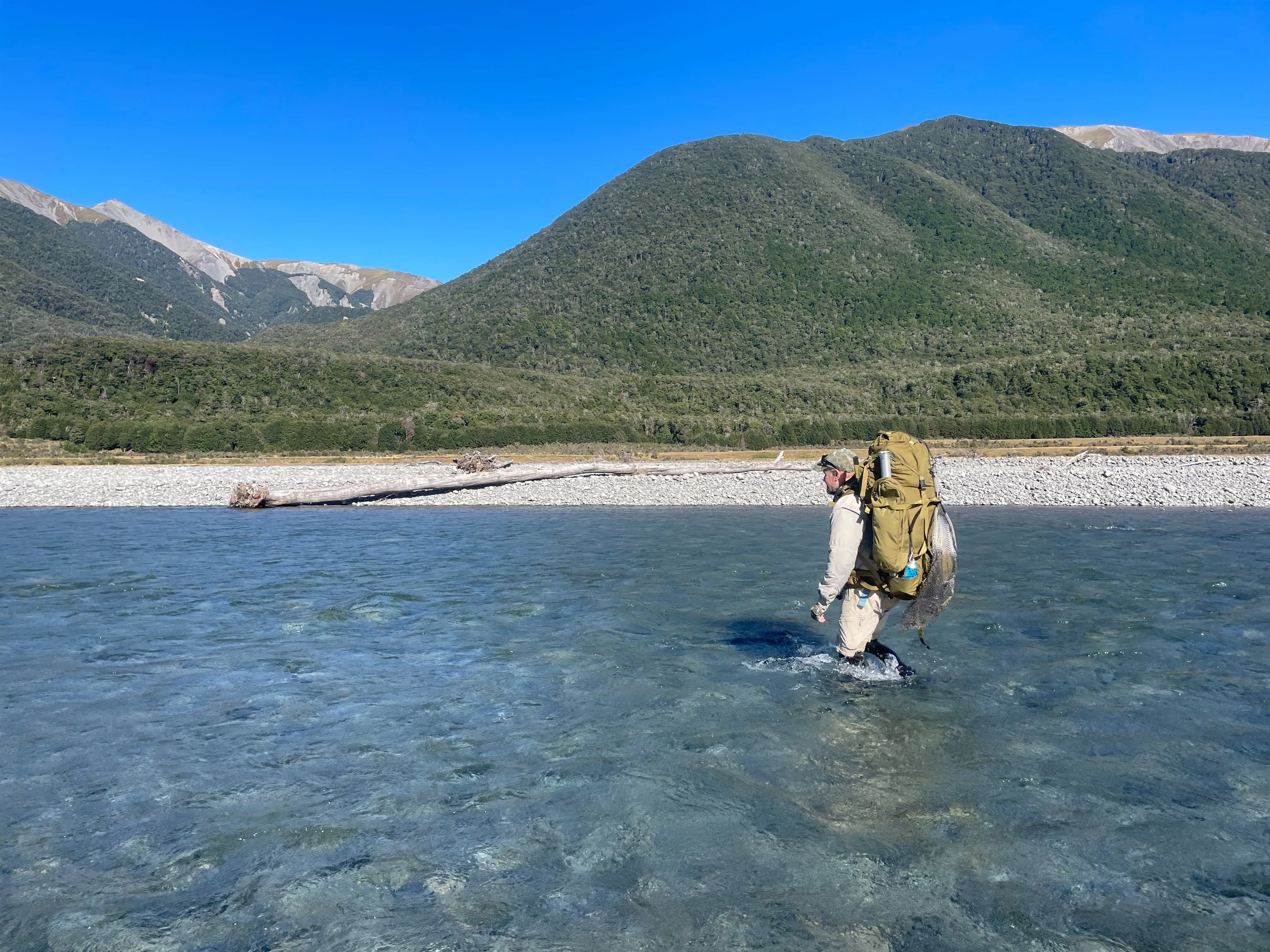
Kresten and I did the massive hike in to the river which took about three hours, not helped by Kresten’s massive 125 liter backpack and ex-military pride (stubbornness) to carry his heavy pack all the way. We caught a few fish on our way to our campsite. They were nice, clean fish in the 4-5 pound range, but they certainly hadn’t been on the protein rich diet we had hoped for. We set up camp as the sun descended behind the Southern Alps and had a quick dinner before checking out Home Pool for an evening rise. We soon spotted a trout, but it wasn’t rising. Instead, it was swinging deep down in the current of the head of the pool. Numerous casts later, after hitting just the right spot in the seam of two currents, the heavy nymph sank down and the fish took Kresten’s fly. It turned out to be a good-sized rainbow, but sadly just before I was able to net it for him, the hook pulled. As we learnt later, this would turn out to become a recurring theme…
The following day, high on caffeine from the morning’s cowboy coffee, we marched upstream. After a while, we spotted a feeding trout. With the lost fish from last night still in our minds it was only fair to have Kresten get the first shot. It wasn’t exactly throwing itself at the well-presented nymphs at the end of Kresten’s leader, but in the end he got a satisfying take. Once he got into contact with the fish it immediately took a run for it. Kresten really had to pull hard during the fight, but luck was ultimately on the fish’s side as the hook pulled during the middle of the fight. Imagine the disappointment!
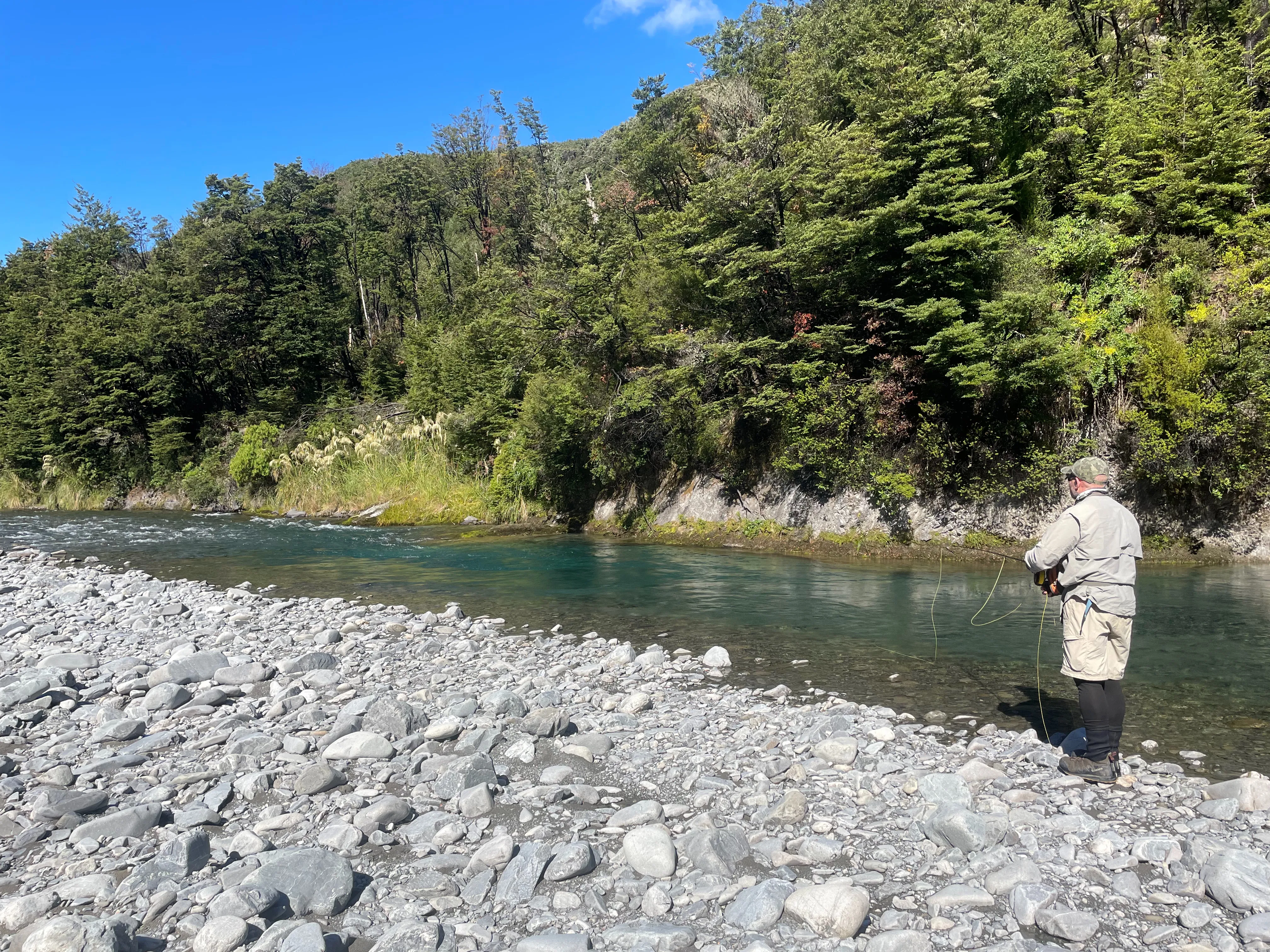
By the time we reached the next pool I was up again. The pool was a classic, glassy pool with a trout sitting almost motionless in the tailout. Remarkably, the fish didn’t spook after the first few casts but neither did it take my fly. Only after changing to a big size 10 black stonefly nymph did it move to ever so slowly inhale my fly. I could see the mouth flash and when its jaws finally closed I lifted my rod. Regardless, the hook didn’t stick. This was our third fish we had lost in a row. This normally isn’t that big of a deal, but in New Zealand every fish counts. Plus, you can see what you just lost!
It was now mid-afternoon and we had walked all day. We did each get a few more shots at fish, but with nothing but a small two-pound rainbow for Kresten to show for it. At least we had now caught a fish, but our hopes for bigger specimens weren’t exactly coming to fruition. Little did we know what was about to happen.
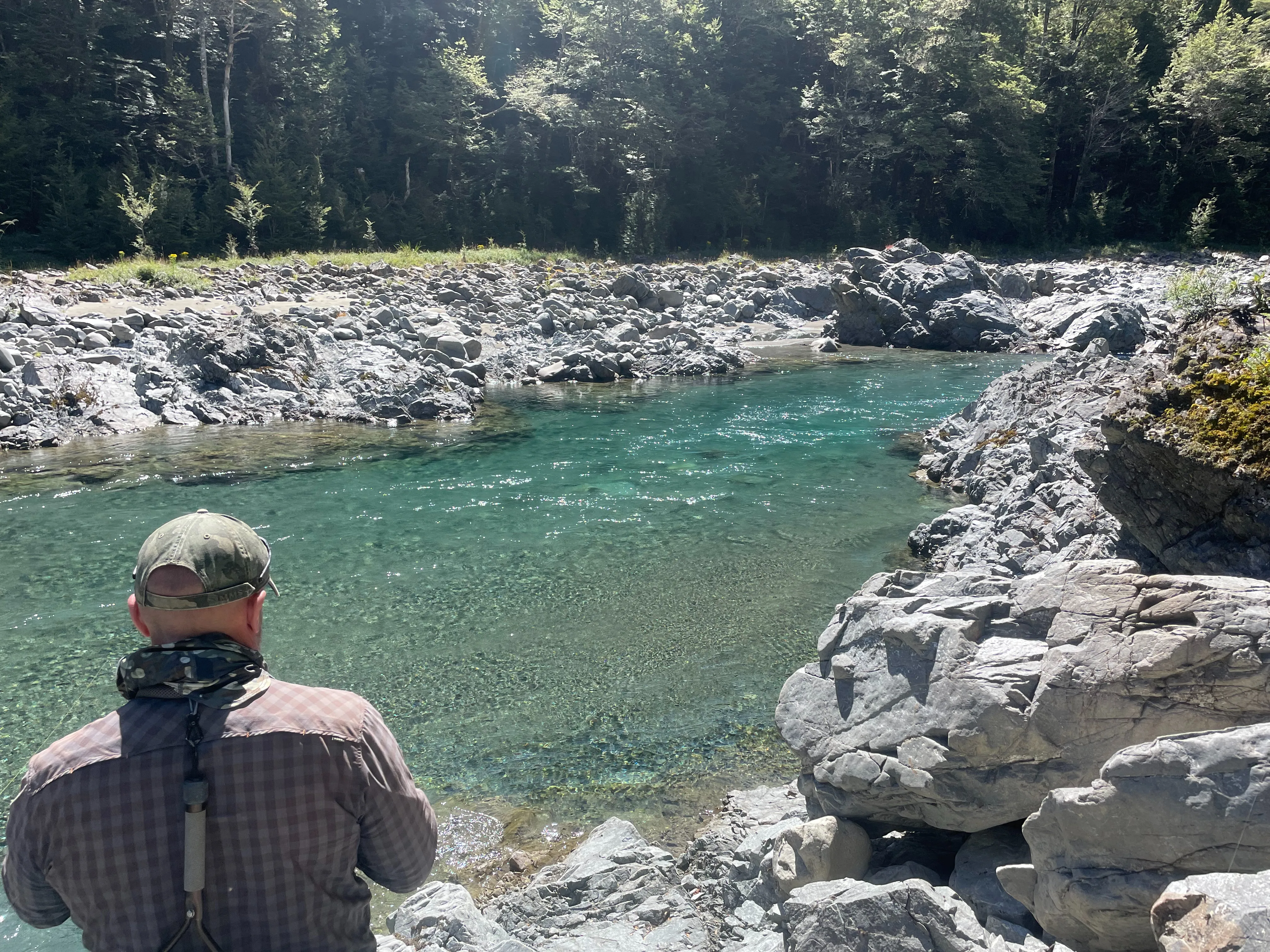
Ahead of us was another very nice pool with the bedrock creating a narrow channel of heavy flowing water. When we approached the tailout of the pool we were shocked when we spooked a massive brown trout that was sitting under a ledge in very shallow water. It looked very large, potentially a double-figure fish (a fish weighing over 10 pounds.) What followed was even stranger. Instead of fully spooking—as brown trout usually do—it simply moved into the main body of the pool. Here we saw it together with at least three other big fish, and of course the spooked fish caused a lot of commotion causing all the fish in the pool to move around. I thought to myself that it was game over to catch any of these fish. Fish that by the way all looked like they had trophy potential! But after a few minutes the fish seemed to settle down. One of them even began actively feeding again. As I drew on my past experience from the last time there was a mouse season in 2019/2020 I started to recognize their behavior as the fish being on mice! There might yet be hope for us to get a chance at these fish, I thought.
Now, mouse fish behavior requires a bit of explanation: A normal New Zealand brown trout will freely feed in the gin clear water, swinging to either side of its lie to take nymphs and dry flies drifting by. These fish are typically willing to take an angler’s fly and will move to take it so long as it is carefully presented in its feeding window. On the other hand, trout that are feeding on mice—mouse fish—are so well fed that it makes little sense for them to expend energy to take a tiny mayfly or caddis nymph. Instead, they tend to sit in deep, well oxygenated water where they can digest all the mice they have been eating during the night. So do you catch them on a mouse fly during the night? Well, possibly, but the main attraction of fishing in New Zealand is to sight fish to spotted fish in crystal clear water. Luckily, these mouse fish will take a fly, but you have to present it absolutely dead-center right in front of the fish for it to take the fly. My analogy for this behavior is Christmas dinner. You have been eating all night and are absolutely full. But when the chocolates or sweets are sent around the table, can you resist having one? I thought so, and neither can the trout.
Back to the pool with at least four trophy trout in it. Kresten was up first and was targeting the fish closest to him in the back of the pool. Knowing from past experience how mouse fish can still be caught even after having been soft-spooked, Kresten rigged up with a heavy nymph. There was a strong current in the pool and even when Kresten put on his heaviest tungsten-wrapped, bead-head nymph, he would still have to make just the right cast to get it to cut through the current and reach the fish’s feeding zone near the bottom. Now it was just a matter of repeatedly casting until the trout would hopefully take the fly, as can be the case with big fish feeling comfortable in the cover of the strong current.
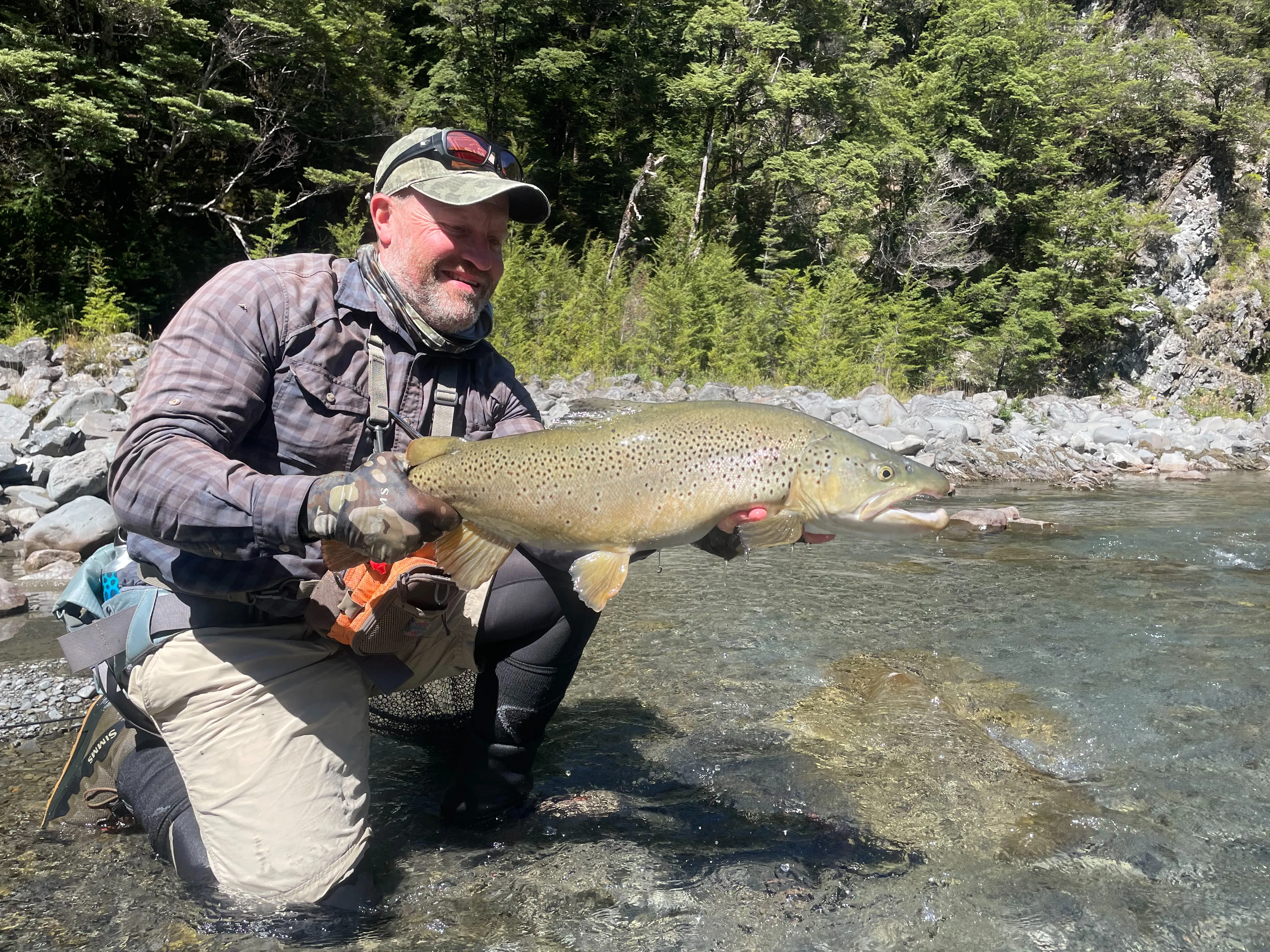
Meanwhile, I had lit my pipe and was puffing away when suddenly Kresten shouted “It’s on!” He almost sounded like he was in disbelief after casting so many times, but his initial reaction soon turned to excitement and anxiousness. This was a fish you wouldn’t want to lose! Thankfully, the 3x tippet (0.20 mm diameter) had just been retied to the leader, and Kresten managed to pull the fish out of the heavy current and away from the rocky ledges. In the back of the pool, a shallow tailout had formed. With not nearly as much water under the bow of the fish, he was able to keep it under control. Finally, the fish flipped on its side in the shallows and I could do a top-down net job of his magnificent capture. On Kresten’s sixteenth trip to New Zealand this was his personal best brown trout. Needless to say, we were over the moon and the trip was saved!
At this point, neither of us expected to catch anything alike on this trip again. However, while we had been weighing and photographing the fish the pool had gotten a rest. The other fish had resumed feeding and now it was my turn!
While Kresten’s fish was feeding directly in the middle and deepest part of the pool, my equally-sized target fish was feeding closer to the almost vertical bedrock wall. It was a much harder cast for me, but by crossing the river and casting from the far bank I managed to get some good drifts. It was the same deal as before so I rigged up a heavy size 10 Perdigon—mainly used as ballast—followed by a size 16 Kalamata nymph. The idea was to use the front nymph to cut through the current and have a good dead-drift presentation with the smaller trailing nymph. I was repeatedly casting to the fish to try to home in on getting the right drift when instinct took over. I lifted my rod and the fish was on! My fiberglass rod bent deeply but the fight wasn’t erratic, rather it was a real tug of war with the constant risk of the tippet being cut off by the rocky outcrop. I could see every move of the fish in the transparent depths of the pool, and once it revealed its girth by showing itself to side-on I was starting to think that this could be an even bigger fish than the one Kresten had just caught! Several times the fish threatened to lodge itself in narrow cracks in the bedrock, but in the end I managed to pull it out of the main body of the pool and into a slow back eddy. Here, in these much safer waters, I could slowly work the fish to the surface and lead the trout to what ended with a beautiful net job by Kresten. By this point we were both ecstatic, but it wasn’t until the weigh-net settled at 13 pounds that we fully realized what had just happened. Oh, and by the way, the fish had taken the big size 10 Perdigon nymph!
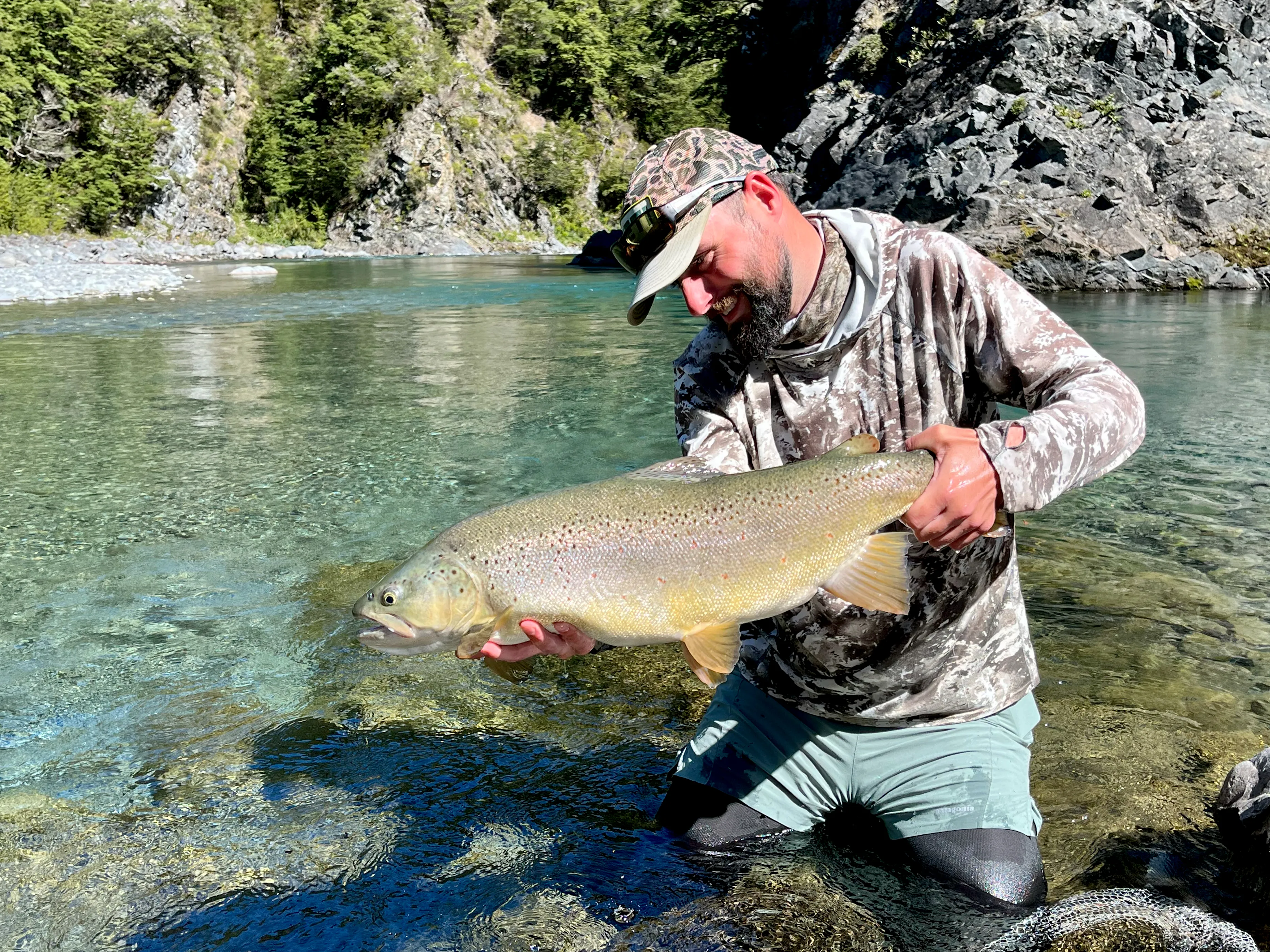
The two of us had just found Shangri-La and had bagged two of the biggest fish we had heard of for several seasons.
We did of course try a few casts for the other fish that was still feeding. However, at this point we felt like we had more than spent our luck and good fortune as the fish became increasingly wary, and in the end we decided to move on. But what did it matter. Personally, I was already more than happy for Kresten to catch a fish of a lifetime when he caught his fish, but to catch two trophy trout—from the same pool—within an hour… This is what dreams are made of!
Text and photos by Chiel Robben, February 2024.